

Why Human Judgment Matters More in the Age of AI at Work

What happens to judgement in the age of AI?
AI can draft a report in seconds, design a presentation in minutes, and summarise a week’s meetings in moments. Organisations revel in this speed. Yet what is often lost in the rush is far more precious: human judgment.
Something fascinating happens when AI enters workflows. Ideas appear almost instantly. Reports draft themselves. Presentations become sharper. Emails more precise. Meeting notes complete themselves before you have finished thinking. Speed, once the hallmark of high-performing teams, suddenly becomes the baseline.
But after the initial thrill, a subtler shift begins. The real question is no longer how fast work can move, but whether organisations remain designed to use human judgment once speed is abundant.
The Hidden Cost of Speed in AI-Driven Work
Human judgment, in AI-supported work, is the ability to interpret outputs, question assumptions, and decide when context, values, or uncertainty call for a different course of action. It is not instinct. It is disciplined sense-making under ambiguity.
AI excels at compressing complexity. It summarises, compares, and recommends with remarkable clarity. Friction that once slowed teams (time spent weighing trade-offs and interpreting nuance) now all but disappears.
Yet what slowed teams was also where judgment lived. When speed becomes effortless, organisations face a choice: keep human reasoning visible, or allow it to vanish.
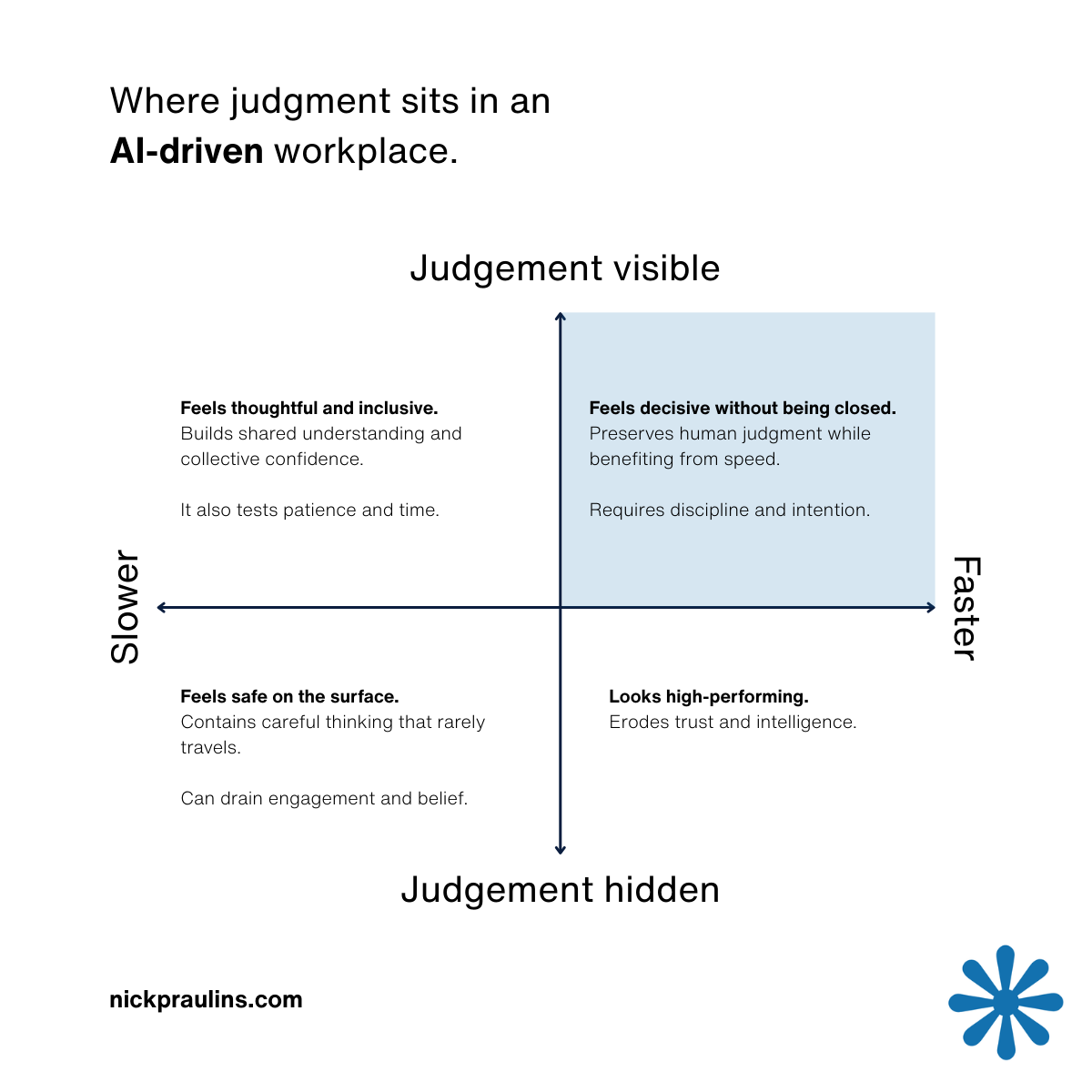
In some cultures, employees are expected to explain decisions and make doubts explicit. Reasoning is visible, and trust grows. In others, conclusions arrive polished and precise, but the thinking behind them disappears. On the surface, efficiency soars. Beneath it, engagement, accountability, and confidence quietly erode.
Human Judgment vs. AI: How Decisions Are Really Made
Look closely at how organisations handle AI-generated outputs and the difference becomes clear.
Are employees expected to challenge AI recommendations, or simply move on?
Is discernment discussed openly, or left to individuals in isolation?
Is judgment treated as a capability to be developed, or as friction to be engineered away?
Consider a familiar scenario. AI drafts an internal announcement or client email based on engagement data. The message is grammatically perfect, concise, and data-driven. What the model cannot see are subtle tone preferences, a recent sensitive event, or the internal politics shaping reception. Human judgment intervenes to pause, review, and adjust. Not because AI is wrong, but because context matters.
When judgment is visible, decisions are resilient. When it disappears, decision-making becomes brittle, optimised for speed but poorly equipped for reality.
Practical Ways to Retain Human Judgement
Some organisations are already experimenting with ways to make judgment explicit rather than implicit:
Decision Logs: Maintain a record of AI outputs alongside human responses and the rationale behind them. This preserves institutional memory and accountability.
Human Annotations: Encourage brief notes explaining why an AI recommendation was accepted, adjusted, or rejected. This keeps reasoning visible without slowing progress.
Reflection Points: Introduce intentional pauses in fast-moving workflows. Questions such as “What assumptions are embedded here?” or “Is there context AI cannot see?” allow disciplined sense-making.
Training and Culture: Develop judgment as a skill. Reward questioning, debate, and explanation, not just speed and precision.
By making reasoning visible, teams ensure that speed is matched with understanding, and that AI enhances collective intelligence rather than replacing it with unquestioned automation.
Why This Matters for Leaders
Leaders can often discern whether judgment is being preserved simply by listening to discussions. When explanations include uncertainty, trade-offs, and dissent, judgment is alive. When conversations leap straight to conclusions (however polished) they reveal that human reasoning has already been removed.
The question is not whether AI improves efficiency. It clearly does. The question is whether organisations remain designed to use human judgment once speed is no longer scarce.
Human Judgment Is the Real Scarcity
Inside modern organisations, speed is abundant. Human judgment is not.
Judgment interprets data, navigates trade-offs, and decides what matters in context. Without it, even the most advanced AI systems produce work that looks intelligent but lacks depth, credibility, and meaning.
The defining question for leaders is no longer how fast teams can move. It is whether organisations remain designed to use human judgment, or whether they are gradually learning to operate without it.
