

Europe Speaks Many Languages: Your Brand Voice Should Too

In many parts of the world, there’s a common perception that people from Nordic countries often speak better English than native speakers! Grammar is precise, vocabulary is confident, and accents are comparatively neutral. In many rooms, it is the native speaker who rambles, jokes too much, or takes longest to get to the point.
But fluency does not equal neutrality.
Even in organisations with high English proficiency, English is rarely a blank canvas. It carries power. Who speaks first, whose humour sets the tone, and whose way of speaking defines what professional sounds like all shape influence, visibility, and brand perception.
For European organisations operating across multiple markets, this tension shows up everywhere. In meetings. In internal chats. In leadership updates. In brand and employer communications. Without deliberate design, the same organisation can sound warm and human in one market, clipped and transactional in English, and overly deferential in another, while everyone assumes this is simply how English works.
This is not a stylistic quibble. It is a governance challenge. And like most governance challenges, it can be addressed with clear definitions, explicit rules, and practical tools.
The three common failure modes
Across European headquartered organisations with English as the working language, the same patterns repeat. They are solvable, but only if they are named clearly and treated as operational problems rather than personal preferences.
The native speaker trap
Native English speakers often improvise and ignore style guidance because it just sounds better to them. Non-native colleagues tend to follow guidance around the use of English quite rigidly because it feels safer. Over time, this embeds inequality and inconsistency into the system.
Fluency is also frequently mistaken for seniority. Confident English can be read as more strategic or more executive, even when the underlying thinking is weaker. This quietly distorts influence, visibility, and promotion decisions. Addressing it requires designing how English should function when different fluencies meet, rather than leaving outcomes to improvisation.
The copy-paste brand voice
Many teams translate a master English tone line-by-line into other languages, assuming equivalence. In practice, voice and tone rarely survive direct translation without adaptation. A playful English tagline can sound childish in one market and rude in another. A direct English instruction can feel efficient in one context or perhaps authoritarian elsewhere. Without deliberate design, a single brand can unintentionally fragment into several different ones.
The email (or Slack) ice age
In internal English channels, non native speakers often overcorrect for professionalism and remove warmth. Messages become short, factual, and stripped of social cushioning.
Colleagues mirror this tone. Over time, fewer people ask clarifying questions, fewer people share early drafts, and more decisions are made in private. Collaboration slows. Psychological safety erodes. This effect is subtle, but it is measurable and reversible with clear examples and shared norms.
Practical guardrails for leaders
The core task for leadership is to treat tone as infrastructure rather than decoration. In organisations operating across languages, this is basic operating hygiene.
Define your brand voice
Before adapting language across markets, you need a clear, shared brand voice. Brand voice describes who the organisation is and how it communicates consistently, independent of language, context, or channel. It is the foundation for all tone decisions.
For example, a brand voice might be defined in plain terms as:
Optimistic: Conveys confidence and a forward looking perspective
Informed: Demonstrates expertise and evidence based reasoning
Pragmatic: Focuses on clarity and actionable guidance rather than abstract ideals
This definition gives teams a north star. The voice stays stable. Tone is how that voice is expressed differently depending on situation, audience, and language.
Separate voice from tone across languages
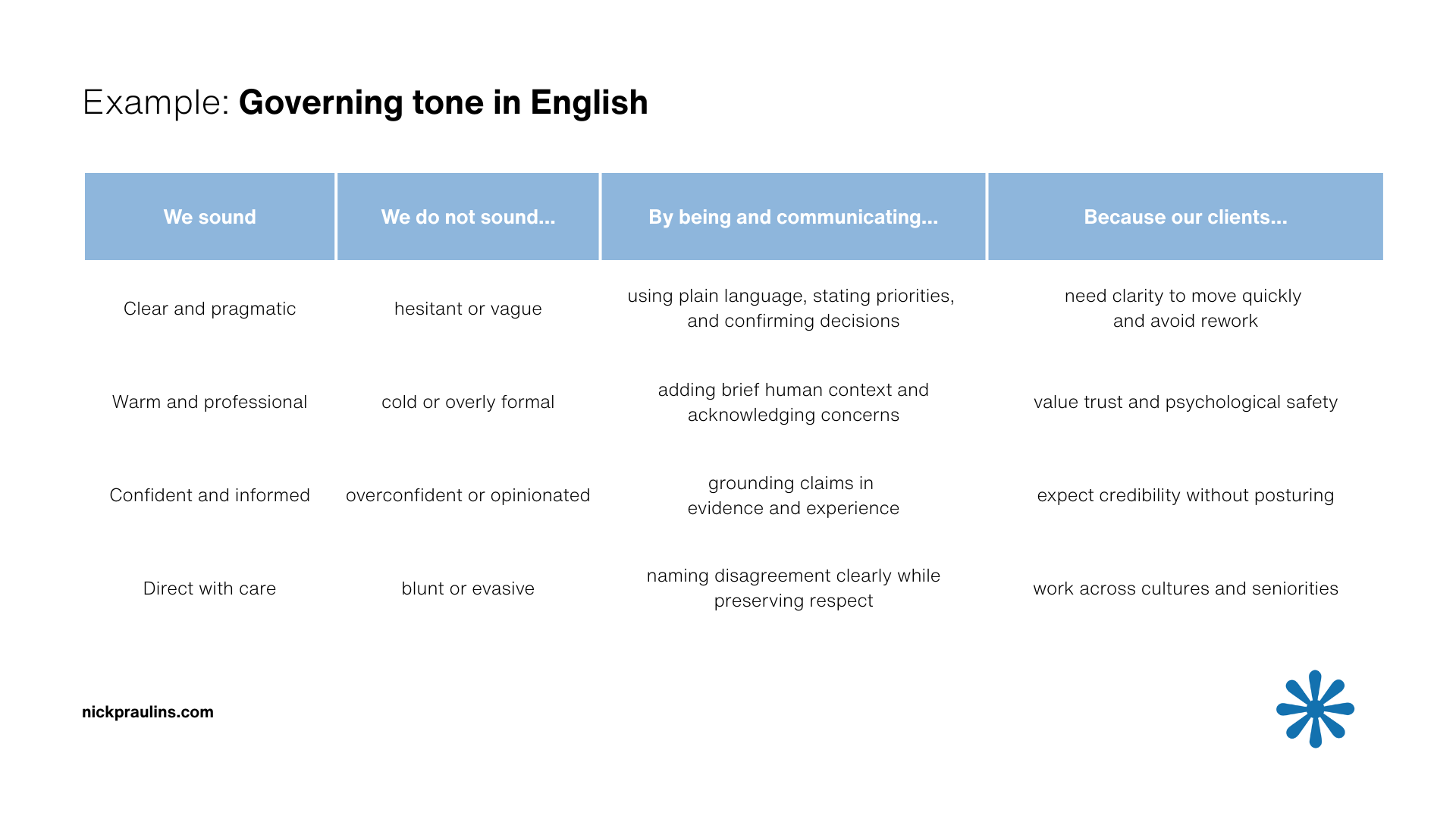
A shared brand voice is only useful if it can be expressed consistently and credibly in practice. Once the voice is defined, tone can be operationalised using practical sliders such as more direct or indirect, more formal or conversational, and more concise or more explanatory.
What matters is not theoretical correctness but behavioural clarity. Teams need to know how the brand should actually sound in English in different contexts.
Below is an example of how the same brand voice can be translated into actionable guidance for English communication, providing a template that can be adapted to other markets.
Minimum viable tone governance
Tone should be governed like any other operational system.
Define what is in scope. Leadership communications, policy updates, crisis messages, hiring templates, employer branding, and key customer journeys.
Define decision rights. Central brand owns the shared voice. Local markets own linguistic credibility and cultural fit. A small cross market group resolves escalations and final wording in sensitive cases.
Create a lightweight rhythm. Periodic audits of high impact templates and spot checks on major announcements are enough to prevent slow drift.
The subtle choices made in English meetings, chats, and emails shape brand perception far more than any manifesto on a website.
Designing a brand voice that travels
Organisations that get this right treat English as one expression of a broader brand personality and not the default against which everything else is measured.
They start from a strong, clearly articulated voice, design how that voice appears in each language, and support it with examples, tools, and decision structures that teams actually use.
English is not going away. But the assumption that everyone will simply adapt to its quirks is increasingly difficult to defend. By defining a clear brand voice, translating it into actionable tone guidance, and putting practical governance in place, organisations can turn English from a source of friction into a tool for alignment, trust, and consistency. Designing this system need not be left to chance. With structured tone-of-voice support, it is possible to create a living framework that teams can use every day, ensuring that your brand sounds coherent, confident, and human across all markets.
